

THE ECHO: The journey continues
This is a journey, an echo, a small ripple. We invite you to think deeply about the interconnectedness of life and the impact we all have. Discover the profound philosophies of Bert Russell and how they can guide you towards peace of mind, body, and soul. Welcome to a path less traveled, where every thought creates a ripple.

Ignite your thoughts: The ripple effect
We want our audience to think. This is a journey, it is an echo, it is a small ripple. The third perspective is the Gravitational Pull Series, starting this coming week from August 23rd to August 30th. Do not miss it! It is a profound exploration of peace for your mind, body, and soul. ✌️

A message for humanity: Guiding future generations
This journey is meant for the world and all humanity. Specifically, it is for parents with children. Parents with children still have a chance to shape their children's lives for the better, fostering peace of mind, body, and soul. ✌️ Discover insights that can transform your family's journey.

Bert Russell's unique perspective: Seeing beyond the obvious
ONE JOURNEY. FOUR PERSPECTIVES.
Mission Statement:
My thoughts often connect through images, memories, patterns, and stories, but they do not always move in a straight line. I chance upon thoughts, follow unexpected connections, and search for answers to questions that keep changing as I learn more. Sometimes I run into roadblocks or knots. I take turns and U-turns, revisit ideas, and sometimes find myself going in circles. At times, I may even feel as though I am moving backwards or confusing the people I am trying to reach.
These four interconnected websites give those thoughts a place to take shape. Each site has a distinct role, while all four contribute to the same body of work.
Lakelife4u is about reflections: the quiet moments, memories, images, and observations that help me notice what is happening within and around me. It is a place to pause, look again, and consider how experience becomes understanding.
PeaceFourU.org faces IT: the information, technology, and practical challenges that shape how we learn, communicate, organize, and connect. It explores the roadblocks and knots we encounter while looking for tools, approaches, and ways forward.
H2Olifestyles has gravitational pull. Like water responding to the forces around it, this site gathers the practical, personal, and creative elements that influence how we live and learn. It draws ideas together, helping them move from reflection into everyday choices, habits, and action.
peace4allmankind is the ripple effect. What begins as one thought, story, strategy, or act of understanding can move outward, reaching other people and creating further possibilities. It considers how individual learning and communication can contribute to wider connection, compassion, and peace.
Together, the four websites form a shared landscape. Lakelife4u provides reflection; PeaceFourU.org faces information and technology challenges; H2Olifestyles draws ideas into practical living; and peace4allmankind carries their effects outward like ripples. Links between the sites let you move from an idea to a reflection, from a reflection to a challenge, from a challenge to a practical response, or from a personal response to a wider possibility.
Everyone arrives with different interests, experiences, and ways of thinking. You may be drawn to one website more than the others, or follow a path that is entirely your own. Yet those who choose to explore these connected spaces may find themselves moving toward similar destinations: greater understanding, practical insight, creative possibility, and new ways of thinking about how we learn, communicate, and make meaning.
As someone with dyslexia, I have learned to work with the ways my mind notices patterns, holds onto images, and makes connections. I have also learned that communicating those connections to others can be difficult. I may try to explain an idea several times, change direction, or discover that my words have created more confusion than clarity. I share the reading, writing, organizing, and communication approaches that have helped me, along with the adjustments I am still figuring out. They are personal strategies, not universal solutions, but they may offer a useful starting point or prompt you to notice what supports your own mind. Across the websites, you will find reflections, explanations, examples, and resources shaped by my experience, with room for you to adapt, question, or leave them behind.
You may enter through any of the four websites, but you are exploring one connected body of work. Each site has its own focus and character, yet all of them lead back to the same questions: How do we think, learn, communicate, and make meaning in ways that fit our individual minds? How do we find our way through the roadblocks, knots, turns, U-turns, and circles that are part of learning and communicating? And how can we keep searching for better answers without losing sight of the questions that brought us here?
Education opens the door. Every mind finds its own way through.
—Bert Russell
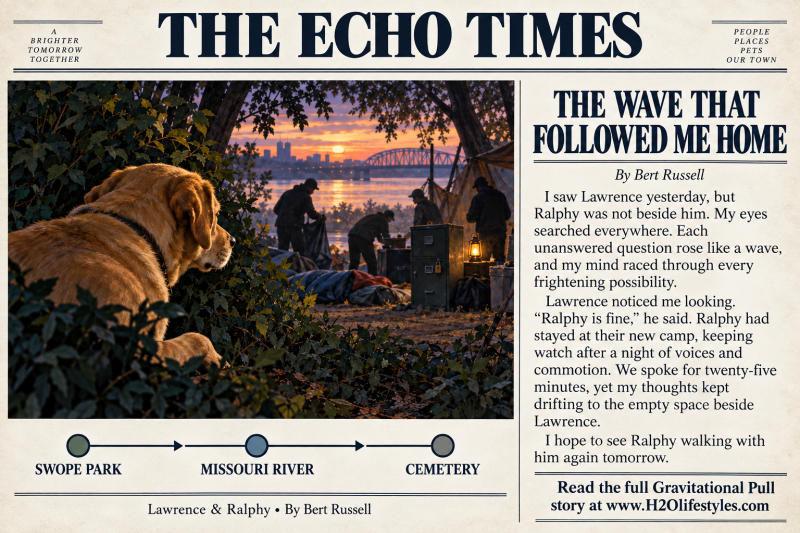
Gravitational Pull
The Wave That Followed Me Home
I saw Lawrence yesterday, but Ralphy was not beside him.
My eyes searched behind Lawrence, then east and west. I turned my head from side to side, looking up and down. No Ralphy.
The first wave was worry. Where was he?
Then came another. Had I missed a comment or a hint the last time we spoke? My mind rolled our conversations backward and forward. I imagined a dogcatcher, an accident, someone hurting him. Each thought rose before the last one had settled.
As Lawrence walked toward me, he seemed to notice me searching.
“Ralphy is fine,” he said.
Lawrence explained that Ralphy had stayed at their new camp to guard their belongings. There are people using drugs and stealing nearby. Ralphy needed rest, too. He had been awake all night, listening to voices and commotion from sundown until sunrise.
Relief came over me, but the waves in my mind did not stop at once.
I pictured Lawrence and Ralphy at the camp, alert to every sound. I could imagine Lawrence sitting quietly, watching what happened around them. Ralphy was harder to picture resting. He is protective, and Lawrence treats him like a son. They go everywhere together.
We talked for about twenty-five minutes. I remember little of what we said because part of my mind was still searching for the dog who was usually at Lawrence’s side. I tried to hide my concern, though Lawrence may have seen it before he spoke.
“Ralphy is fine.”
I held on to those words as the worst thoughts slowly lost their force.
I hope I see Ralphy tomorrow, walking beside Lawrence again. Until then, I know he is at their camp, getting the rest he needs. And I am waiting for the last wave of worry to settle.
Gravitational Pull - waves of anxiety. ✌️
—Bert Russell

THE ECHO TIMES
September 16, 2026
THE LAWRENCE AND RALPHY SERIES
A NEW RECIPE—AND A NEW PLACE TO SLEEP
Yesterday, Lawrence and Ralphy were waiting for me at the bus stop.
The moment Ralphy saw me, his tail began wagging so fast that his whole body seemed to join in. He walked over and sat beside my feet. I reached down and petted him.
I had brought something special for both of them.
I recently started experimenting with a new recipe for homemade steak jerky. I gave Ralphy one piece and handed Lawrence a reusable container filled with more.
“Give it a try,” I told him. “Then tell me whether you like it.”
I asked if he and Ralphy would become my official taste-testers until I could master the recipe.
Lawrence smiled and agreed.
He also promised that he would wash the container and return it to me.
It was a small exchange—some homemade jerky, a borrowed container and a promise to bring it back—but it felt like something more.
We stood near the bus stop without saying very much. We were not conducting an interview or trying to fill every moment with words. We were simply socializing, almost as though we had known each other for years.
I enjoyed the conversation.
I even enjoyed the loitering.
As we stood there, I found myself wondering about Lawrence’s past. What happened along his journey? Was there a falling-out with someone? Did one desperate moment lead to another until the street became his home?
I do not know.
Lawrence has never told me the entire story, and I have learned not to force questions into places where trust is still growing. Sometimes friendship begins by allowing another person to reveal his story at his own pace.
Then Lawrence told me that he and Ralphy were searching for a new place to sleep.
Swope Park, he explained, was cracking down on people sleeping there. He wanted to move closer to a library.
“Which library?” I asked.
“Independence,” he answered.
He said being near the library would give him better access to books, computers and the research he has been learning to do. However, he was concerned that drug activity in the area could become a problem.
He said he would figure it out.
For the past couple of nights, Lawrence and Ralphy had been staying near a cemetery close to Interstate 435.
Then Lawrence said something that caught me off guard.
He said he loved his new view.
I could picture him looking across the cemetery in the darkness, finding beauty and stillness in a place most people would avoid. Yet I could not ignore the reality beneath those words. A peaceful view is not protection from cold temperatures, storms or the dangers of sleeping outside.
Winter is approaching.
Soon, a windbreaker and a loyal yellow Labrador will not be enough to keep Lawrence warm. The libraries will close each evening. The buses will stop running. The temperature will fall, and Lawrence and Ralphy will still need somewhere safe to sleep.
I worry about both of them.
Before we separated, Lawrence and Ralphy boarded the next bus together. I watched them leave, heading toward another unknown stop on a route no computer could completely optimize.
Perhaps Lawrence will return with a clean container and a review of my newest recipe.
Perhaps he will also return with a safer place to sleep.
Until then, one question remains:
How can a man be surrounded by homes, libraries and public transportation—and still have nowhere safe to go when night arrives?
Peace, brother.
One Question. Four Perspectives.
The Journey continues—and it is up to you.
THE ECHO
GRAVITATIONAL PULL
THE GRAVITY BETWEEN US
Yesterday, shortly before lunch, I looked through the window at work and saw Lawrence and Ralphy.
Several buses passed, but Lawrence did not board any of them. He remained nearby with Ralphy, almost as if he were waiting for someone.
Perhaps he was waiting for me.
At 10:45 a.m., after several meetings and working on the optimal routes for Tuesday, I finally stepped outside. Lawrence and Ralphy began walking toward me.
Ralphy’s tail was wagging. I reached down to pet him, but Lawrence spoke first.
“How are you, George?”
“Great,” I answered.
Then he asked how my weekend had gone.
I told him that I had traveled to several estate sales and returned home with approximately thirty items. He wanted to know whether I thought I might make money from any of my purchases.
I shrugged my shoulders.
“I never know, Lawrence. I may see the value, but I never know whether the public will see the same value in their minds.”
That may be one of the mysteries of value.
An object can sit unnoticed on a table for years. One person sees clutter. Another sees history. Someone else sees a childhood memory, a missing piece of a collection, or something worth rescuing from being thrown away.
Lawrence then asked how I sell the things I find.
“On the internet,” I told him.
He said he had been practicing his web searches and learning as much as possible at the public library. Then he asked a question I was not expecting.
“Could I help you find stuff?”
I paused.
I did not want to dismiss the offer, but I also did not know what he could find, what he remembered, or where this new idea might lead us.
I suggested that he continue practicing his internet research. I told him to begin by looking up items he remembered from his own past. He could research what they were, when they were made, and whether people value them today.
He said he would.
Perhaps learning to recognize the value of forgotten objects might also help someone recognize the value of forgotten memories.
Before leaving, Lawrence told me he was headed to Lee’s Summit, Missouri. I asked him why.
He said the library there offered more books that connected him to a different world than the books available to him in downtown Kansas City.
His answer stayed with me.
Are the books actually different at a suburban library than at a downtown library? Are the available services different? Does one library reflect a different community, history, or set of possibilities?
I honestly do not know.
It is a question I will ponder—and perhaps research—this week.
I spend my working days planning routes. I look at distance, capacity, service times, equipment, and all the other forces that determine the most efficient path from one destination to another.
But Lawrence follows routes that no computer could completely optimize.
A bus ride may take him across the city in search of a book. A library may connect him to knowledge that his present circumstances cannot provide. A conversation outside my workplace may connect his curiosity with my search for forgotten items and untold stories.
That is gravitational pull.
Gravity does not always drag us downward. Sometimes it pulls us toward a person, an idea, or a possibility we might otherwise have passed.
Something pulled Lawrence toward that window yesterday.
Something pulled me away from my computer and outside to meet him.
Something pulled Ralphy forward with his tail wagging, as though he already understood that friendship does not always need an explanation.
When the bus finally arrived, Lawrence and Ralphy climbed aboard.
“See you tomorrow,” Lawrence said.
“I hope to see you as well.”
After the bus pulled away, I began thinking about our new friendship. Lawrence and I live very different lives, yet our paths continue to cross.
Maybe friendship has its own gravity.
It does not ask where you sleep, what you own, or how the rest of the world measures your worth. It simply draws two people closer through recognition, conversation, curiosity, and time.
I am happy every time I see Lawrence and Ralphy.
Perhaps they are waiting for me.
Perhaps, in a way I am only beginning to understand, I am also waiting for them.
CLOSING QUESTION
What person, possibility, or forgotten story keeps pulling you closer—and what might happen if you stopped resisting its gravity?
The Journey Continues…
One Question. Four Perspectives.
www.H2Olifestyles.com
THE ECHO
GRAVITATIONAL PULL
THE CHOICES WE THOUGHT WERE OUR
We like to believe that we independently choose where we go, what we value, and who we become. Yet every person lives inside an invisible field of influence.
Society tells us what success should look like.
Family gives us traditions, expectations, and hopes.
The digital world measures our worth through views, reactions, and followers.
None of these forces is automatically harmful. Social influence can introduce us to new possibilities. Family expectations may come from generations of love, sacrifice, and experience. Digital attention can connect people, amplify meaningful stories, and help someone who once felt invisible finally feel seen.
The problem begins when we stop recognizing the pull.
A young person may pursue a respected career because everyone says it would be “perfect” for them. They may succeed, earn praise, and build a comfortable life—yet quietly wonder why that life never feels like their own.
Another person may continue a family tradition because changing direction feels like rejecting the people who helped them get started. Love becomes tangled with obligation. Gratitude becomes difficult to separate from guilt.
Then there is the gravitational pull of digital attention.
A photograph receives more reactions than expected. A personal story attracts new followers. A video reaches thousands of strangers. The attention feels encouraging, so the person creates another post—and then another.
Gradually, an honest moment can become a performance.
The question changes from “What do I want to express?” to “What will people respond to?”
Eventually, people may find themselves making decisions for an audience they have never met. They visit places because the pictures will look impressive. They reveal private moments because vulnerability attracts attention. They measure an experience by how it performs instead of how it feels.
No single person or platform deserves all the blame. Most families do not intend to limit someone’s future. Most friends do not deliberately pressure one another. Most people using social media are simply looking for connection, encouragement, or a place to belong.
These forces often begin with something human: love, acceptance, security, recognition, or the desire not to disappoint anyone.
That is what makes their gravitational pull so powerful.
The strongest influence may not be the voice demanding that we obey. It may be the quiet voice suggesting that we will be loved a little more, accepted a little faster, or noticed a little longer if we move in a certain direction.
Over time, these small adjustments can become a life.
Perhaps the answer is not to escape every outside influence. That would be nearly impossible—and possibly lonely. We need relationships, guidance, communities, and shared experiences.
The answer may simply be learning to pause.
Before accepting the next expectation, following the next trend, or posting the next private moment, we can ask:
Is this helping me discover who I am—or teaching me how to become what others expect?
Would I still make this choice if nobody applauded?
Does this direction bring me peace, or does it only bring me approval?
We cannot eliminate gravity. We can, however, recognize what is pulling us. Once we recognize it, we regain the ability to decide whether that force deserves to determine our direction.
Sometimes the smallest pause is the first step back toward a life that truly feels like our own. ✌️ ☮️
Closing Question:
What is quietly pulling you—and would you still choose that direction if nobody were watching?
The Journey — The ECHO
One Question. Four Perspectives.
www.H2Olifestyles.com
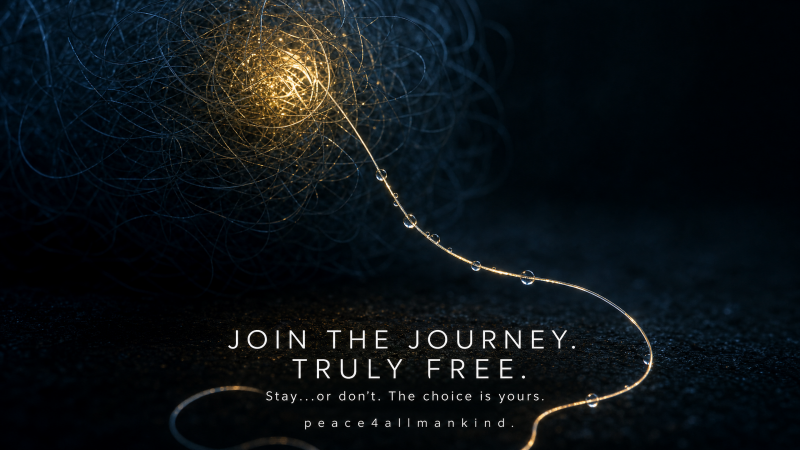
THE ECHO TIMES
GRAVITATIONAL PULL SERIES
SMILE, GRIT YOUR TEETH, AND KEEP THE PEACE
- Bert Russell | September 13, 2026
Have you ever had to fake friendliness to keep the peace in a work-related situation?
You put a smile on your face.
You grit your teeth.
You choose polite words while holding back what you truly want to say.
It may not feel honest or natural. Sometimes, however, keeping the peace is not about pretending that everything is fine. It is about recognizing that every thought does not need to become an argument—and every feeling does not need to become an action.
There is a difference between being fake and practicing self-control.
A forced smile may begin as a mask, but compassion asks us to take one more baby step. Instead of simply acting friendly, can we sincerely try to understand the other person?
Maybe they are carrying pressure we cannot see.
Maybe their life outside work is falling apart.
Maybe they are also smiling, gritting their teeth, and trying to survive the day.
Compassion does not mean accepting disrespect. It does not require us to surrender our boundaries or remain silent when something is wrong. It means remembering that the person pulling against us is still a person.
Consider Earth and the Moon.
Gravity constantly pulls them toward one another, while the Moon’s forward motion keeps it from falling directly into Earth. The result is not an escape from the pull. It is an orbit—a continuing relationship shaped by attraction, motion, distance, and balance.
Work relationships can feel similar.
Different personalities pull against one another. Deadlines create pressure. Pride adds weight. One careless comment can disturb the balance and send ripples throughout an entire workplace.
You may not be able to stop the gravitational pull, but you can decide how you respond to it.
Smile if it helps you pause.
Grit your teeth if it keeps harmful words from escaping.
Then take the next baby step: search for enough sincere compassion to mean at least part of that friendliness.
Peace does not always begin naturally.
Sometimes, peace begins as a conscious decision made in an unnatural moment.
THE QUESTION:
Have you ever had to fake friendliness to keep the peace in a work-related situation?
Did that friendliness remain a mask—or did it eventually help you see the other person from a different perspective?
Reflect on the gravity.
Face the gravity.
Then decide what kind of ECHO your response will create.
One Question. Four Perspectives.
The Journey continues—and it is up to you. ✌️

Gravitational Pull
Who will carry on the Legacy?
I live in a community of 66 homes surrounded by an iron fence. It is not officially a retirement community, but most of my neighbors are over 75 years old.
They grew up in a different world.
Many still have landline telephones and answering machines. They write down messages by hand, pay with cash or checks, balance their checkbooks and keep duplicate copies of every check they write. Email, online banking, smartphones and digital accounts were never necessary during most of their working lives.
Now, the world expects them to understand everything almost overnight.
Unfortunately, some people prey upon their unfamiliarity with technology. They mistake innocence for weakness and trust for opportunity. But these older generations are not unintelligent. They carry knowledge that cannot be downloaded from the internet.
I enjoy listening to their stories. They answer questions about history through memories—not search engines. Many of the objects I discover at estate sales came from their childhoods, careers and younger days. When they tell me what those objects meant, forgotten items become pieces of living history.
Over Labor Day weekend, I saw one of my neighbors placing American flags at every corner of our community. I stopped to help him.
When we finished, he looked at me and asked a serious question:
“Does anyone even care about the importance of Labor Day and why the holiday was established?”
I looked him directly in the eyes and said:
“I do.”
I believe my answer surprised him. I am approximately 25 years younger, but I understood what he was really asking.
Will anyone remember?
Will anyone care?
Will someone continue this tradition when I no longer can?
Labor Day is more than the unofficial end of summer. It honors the generations of working people whose labor, sacrifices and determination helped build this country. The flags were not merely decorations. They represented gratitude, remembrance and responsibility.
He cares.
I care.
We should all care.
Perhaps one day I will be the person placing those flags at every corner. Perhaps another neighbor will see me and stop to help. That is how a tradition survives. That is how history travels from one generation to the next—not through technology alone, but through conversations, small acts and someone willing to carry the responsibility forward.
The gravitational pull of progress constantly moves us toward what is new. But sometimes we must resist that pull long enough to listen to those who remember what came before us.
That gentleman was not simply placing flags.
He was passing down a legacy.
And because it matters, someone must be willing to pick it up.
Education is the key. Teaching is the degree.
Gravity never stops pulling.
✌️ of MIND, BODY and SOUL.
GRAVITATIONAL PULL
BELOW THE SURFACE
Gravity never stops pulling.
Memories are interesting things.
Some float right on the surface.
Happiness. Success. Failure. Patience. Humility. Love. Embarrassment. Depression. Lessons learned.
We can reach down and pull those memories out almost anytime we want.
But then there are the others.
The memories we pushed so far down that we hoped we would never see them again.
Fear.
Shame.
Embarrassment.
Regret.
Things we did.
Things that happened to us.
Things we wish we could erase.
Everyone has something buried somewhere. Maybe the details are different, but I believe most of us have memories we would rather leave untouched.
I know I do.
I have tried to bury some of mine.
I have denied they were even there. I have pushed them deeper and deeper into my subconscious and almost held an internal funeral for them.
This memory is over.
It is buried.
Leave it alone.
And most days, it stays there.
But the mind reminds me of the ocean.
Look across the ocean on a peaceful morning and everything appears calm.
Small waves roll toward shore.
Sunlight dances across the water.
Maybe a sailboat drifts across the horizon.
But travel downward.
Farther.
Deeper.
Into the darkness.
The pressure increases.
The deeper you go, the greater the pressure becomes.
Our memories can work the same way.
Some of the greatest pressure may exist beneath the calmest-looking surface.
And every once in a while, something shifts.
For me, sometimes it happens in a nightmare.
A memory I thought I buried suddenly comes rushing upward.
Details return.
Feelings return.
Embarrassment returns.
Fear returns.
It can feel like a tidal wave rising from somewhere deep inside my mind.
Then I wake up.
The room is quiet.
The wave retreats.
And I have a choice.
Do I bury it again?
Or do I ask why it returned?
Maybe we don't have to tell the world every detail of our deepest memories.
Some things can remain private.
The details aren't always the important part anyway.
The lesson is.
Did I learn from it?
Did it change how I treat another person?
Did embarrassment teach me humility?
Did failure teach me patience?
Did fear teach me courage?
Did a mistake teach me never to repeat it?
Perhaps that is how we reduce the pressure.
Not by pretending the memory never happened, but by allowing what it taught us to rise to the surface.
The memory can remain deep below.
But the lesson doesn't have to.
Maybe that is one of life's strangest gravitational pulls.
The past keeps pulling on the present.
And the present determines whether that pull becomes another destructive wave—or a lesson we pass forward.
So I leave you with a question:
What memory have you buried beneath your own ocean—and what did it teach you?
You don't have to tell anyone the answer.
Just don't forget the lesson.
Education is the key.
Teaching is the degree. ✌️
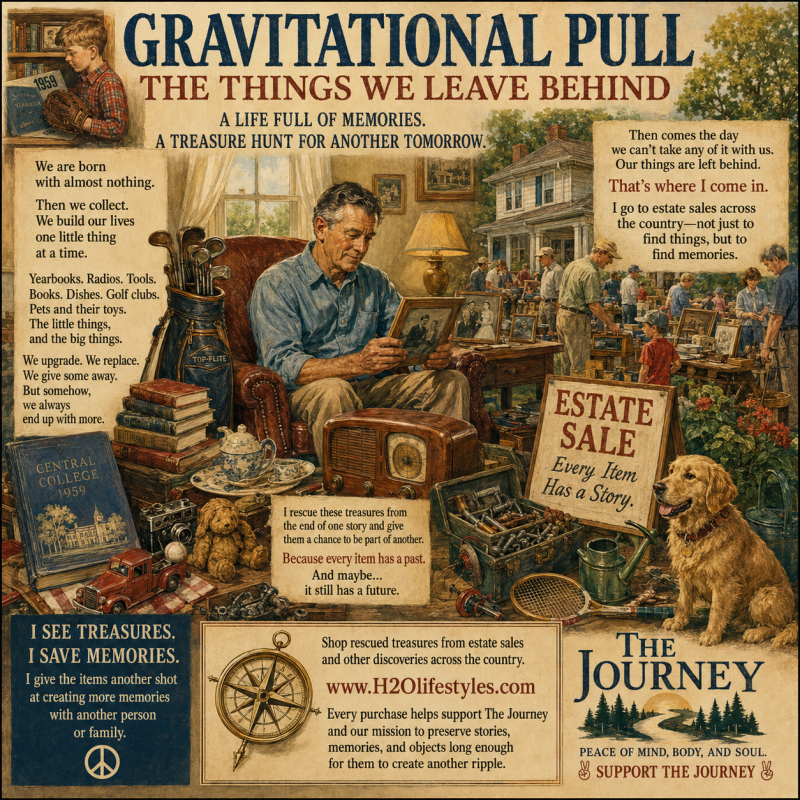
GRAVITATIONAL PULL
THE THINGS WE LEAVE BEHIND
Gravity never stops pulling.
I go to estate sales across the country.
Some people see old stuff.
I see a treasure hunt through somebody's life.
Think about it.
We are born owning almost nothing.
Then our parents start collecting things for us. Clothes. Toys. Books. A bicycle. Maybe a baseball glove, golf clubs or a tennis racket.
We grow up and start buying things ourselves.
Radios. Yearbooks. Dishes. Furniture. Computers. Tools. Books. Sports equipment.
Then comes a house.
And somehow the house starts filling itself.
Every man seems to have a collection of tools, screws, bolts, nails and mysterious fasteners he hasn't used in twenty years—but absolutely refuses to throw away because someday he might need that exact one.
Then there are grills, flowerpots, gardening tools, patio furniture and boxes of things we forgot we owned.
Even the pets get possessions.
Toys. Leashes. Collars. Beds. Sweaters. Sometimes even a stroller.
Children grow up and take things with them.
So we replace those things.
A chair wears out. We buy another.
A bedroom set gets replaced.
A television gets bigger.
A computer becomes obsolete.
Year after year, decade after decade, we accumulate evidence that we were here.
Eventually something happens that none of our possessions can prevent.
Time catches us.
Our health changes.
And eventually we leave this planet.
But our things remain.
Suddenly the golf bag has no golfer.
The cookbook has no cook.
The tools have no hands.
The radio has nobody turning the dial.
The dishes are waiting for a family dinner that will never happen in that house again.
The yearbook is filled with faces nobody at the sale recognizes.
And strangers begin walking through the rooms.
That's where I come in.
I don't go to estate sales simply looking for things to sell.
I'm looking for memories.
I'm looking for something somebody loved enough to keep for 20, 40, 60 or even 80 years.
Something that deserves another chance.
Maybe an old cookbook ends up in another family's kitchen.
Maybe a golf club teaches another child the game.
Maybe an old radio plays again.
Maybe a forgotten book gets opened by someone who needs the exact words printed inside it.
I cannot save everything.
Nobody can.
But every once in a while, I can pull one object from the end of its story and give it a chance to begin another.
That's why an estate sale feels like a treasure hunt to me.
The treasure isn't always the object.
Sometimes the treasure is realizing that somebody was here before us.
They worked.
They played.
They cooked.
They fixed things.
They raised children.
They loved animals.
They collected things they probably didn't need.
They made memories.
And then they were gone.
Their possessions became an ECHO of the life they lived.
Perhaps buying something from an estate sale isn't always about owning another thing.
Perhaps sometimes it is about saying:
Your story doesn't have to end here.
I'll carry a small piece of it forward.
QUESTION EVERYTHING
If the things you own today were spread across tables at an estate sale tomorrow, what would they tell a stranger about the life you lived?
Take the Journey. ✌️
Shop rescued treasures from estate sales and other discoveries across the country:
https://posh.mk/TJuYACRDI5b
Every purchase helps support The Journey and our effort to preserve stories, memories and objects long enough for them to create another ripple.
Peace of MIND, BODY, and SOUL. ✌️

GRAVITATIONAL PULL
BEFORE THE SKY HAD COMPETITION
Gravity never stops pulling.
Astronomy fascinates me.
But there is something else tangled in my mind that has baffled me for years.
Why does the sky seem to pull on us?
I don't know.
I have searched for pieces of the answer in books, spatial geography, psychology, sociology, human behavior, church, faith, family, friendships, relationships and conversations with complete strangers.
I still don't have the answer.
So take a Journey with me.
Go backward.
Before YouTube.
Before the internet.
Before video games.
Before television.
Before cars, streetlights and universities.
Keep going.
Thousands of years.
Now look up.
For much of humanity, the sky was the greatest screen on Earth.
No subscription.
No commercials.
No remote control.
And never a rerun.
Every second brought another image.
Clouds moved. Storms developed. The Sun traveled across the sky. Shadows stretched. The Moon changed. Stars appeared. Planets wandered.
The picture was never exactly the same twice.
Almost like a fingerprint.
An identity.
Imagine sitting outside with your family 5,000 years ago.
There is no glowing phone competing for your attention.
There is darkness—and above you is something enormous.
Naturally, humans began watching.
They noticed patterns.
Day and night.
Seasons.
Moon phases.
Planting.
Harvesting.
Migration.
Weather.
Eventually we learned that some celestial relationships have very real physical consequences. Gravity holds planets in orbit. The Moon contributes strongly to Earth's tides. Earth's rotation gives us day and night, while its orbit and tilted axis create our seasons.
Our ancestors didn't understand all of that science.
But they could observe the patterns.
And humans are pattern-seeking creatures.
Perhaps that helps explain why civilizations connected the heavens with gods, calendars, navigation, agriculture, stories and eventually astrology.
This is where my own curiosity becomes complicated.
I think about birthdays.
I think about people born during certain months whom I seem to understand almost immediately—and others I struggle to understand.
Is that astrology?
Psychology?
Culture?
Confirmation bias?
Coincidence?
Some relationship science hasn't discovered?
I don't know.
And “I don't know” may be the most important sentence in this entire Journey.
Astronomy is science.
Astrology is not scientifically established as a reliable explanation of personality or destiny.
But humanity's fascination with connecting ourselves to the heavens is undeniably ancient.
Maybe that fascination itself deserves investigation.
Second.
Minute.
Hour.
Day.
Month.
Year.
Decade.
Century.
Everything moves through time.
Humans evolve.
Animals evolve.
Plants evolve.
Bacteria evolve.
Atoms and molecules rearrange.
Stars are born and die.
Planets move.
Galaxies move.
And here we are—tiny human beings standing on one planet, looking outward and asking the same question our ancestors probably asked beneath a much darker sky:
What does all of this have to do with me?
Maybe nothing.
Maybe more than we understand.
I'm not ready to answer that.
I'm only asking you to look up.
THE ECHO QUESTION
Before humans had science to explain the sky, why were we already so convinced that something up there was connected to something down here?
Think about it.
The Journey continues. ✌️
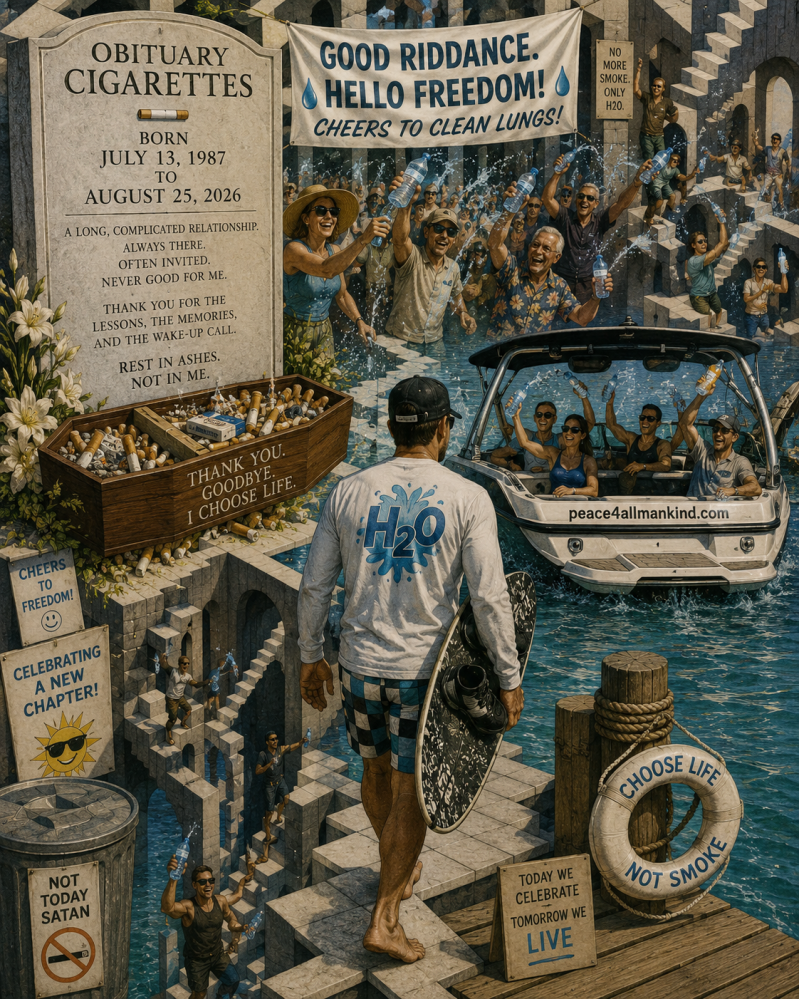
GRAVITATIONAL PULL
(The 3rd Perspective to the Journey)
MY BEST FRIEND MAY KILL ME
Gravity never stops pulling.
I have tried to quit smoking.
And tried.
And tried again.
Yet somehow, I keep going back to my best friend.
Calling a cigarette my best friend sounds ridiculous. Maybe even disturbing. But after years of smoking, that is sometimes exactly what the relationship feels like.
Cigarettes have changed throughout my life almost like girlfriends when I was a teenager.
Different flavor. Different personality. Different smell.
Hard pack or soft pack.
Pack them tight or let them be free.
Hold the cigarette between my fingers or bite gently on the filter.
Put it out halfway—or convince myself to take just a few more puffs.
Smoke it leisurely or hot-box it because I only have a minute.
The brands may have changed.
The relationship didn't.
My cigarette was there during the good times and the terrible ones.
Weddings.
Funerals.
Births.
Holidays.
Celebrations.
Arguments.
Long drives.
Quiet mornings.
And those stressful moments when I didn't know what else to do with myself.
I reached for my friend.
Light.
Inhale.
Exhale.
For me, quitting isn't only about replacing nicotine.
There is something about the ritual that is much harder to explain.
The smoke enters my mouth and lungs. I feel it moving through my throat. Sometimes I exhale through my nose. Usually through my mouth.
Sometimes I make rings.
Sometimes it's just a cloud disappearing into the air.
I can talk while smoking.
I can sit completely silent.
Either way, the cigarette never interrupts me.
It never argues.
It never tells me I'm wrong.
It never raises its voice.
For a few minutes, it seems to agree with everything I say.
Maybe that is why this friendship has lasted so long.
But there is something my best friend doesn't tell me.
It may be killing me.
That's the part I can no longer romanticize.
Every cigarette comes with a price, even when I can't immediately see the bill.
And that scares me.
Quitting smoking may be the hardest thing I have ever tried to do.
I may stumble.
I may crave it.
I may reach toward the place where that familiar pack used to sit.
But eventually we have to recognize when a relationship has become destructive.
Sometimes the strongest gravitational pull isn't between the Earth and the Moon.
It's between your hand and something you've reached for thousands of times.
My friend has traveled with me long enough.
It is time to quit. ✌️
THE ECHO QUESTION
Have you ever had to walk away from something you loved because you finally realized it was hurting you?

ECHO
(The 3rd perspective of the JOURNEY)
GRAVITATIONAL PULL
THE GAME THAT PULLED US TOGETHER
August 23, 2026
Some families pass down land, recipes or traditions. The Russell family passed down a golf swing—and the stubborn determination to keep taking it.
The Russell family grew up around golf.
It wasn't simply something we played. It became part of the current running through the family.
Our fathers are brothers, and they learned the game from their father—our grandfather. Holidays often meant family, food and, somewhere along the way, golf.
Grandfather made sure of it.
He drilled the game into his sons and eventually his grandchildren. Not because golf was particularly important in the grand scheme of life, but because of what the game demanded from the person holding the club.
Persistence.
Patience.
Determination.
And the ability to fail spectacularly, stand there for a moment, and hit another ball.
Grandfather was extremely competitive. Losing didn't sit comfortably with him.
But neither did quitting.
That competitive current traveled into his sons and then into us.
Anyone who has played golf seriously understands that the greatest opponent usually isn't standing across the fairway.
He's standing between your ears.
You can hit a perfect shot and five minutes later wonder whether you've ever held a golf club before.
One hole builds confidence.
The next destroys it.
A six-iron flies exactly as imagined. The divot rises beautifully from the ground. For a few seconds, everything feels effortless.
Then comes the next swing.
And golf reminds you who is actually in charge.
People often say golf is 90% mental.
I'm not sure anyone has scientifically measured that percentage, but after growing up around the game, it feels about right.
Golf exposes frustration.
It exposes impatience.
It exposes ego.
Most importantly, it asks a very simple question:
What are you going to do after the bad shot?
Maybe that's why the game became such a powerful connection in our family.
Grandfather wasn't merely teaching us how to strike a golf ball.
He was teaching us how to recover.
And gravity provides an interesting way to think about that inheritance.
The Moon's gravity helps create the tides. Water rises and falls. Currents move through oceans, rivers and streams, shaped by gravity, terrain, wind and countless other forces.
A stream doesn't argue with the hill.
It encounters rocks, bends, fallen trees and changing ground, yet gravity continues pulling the water onward.
Sometimes gently.
Sometimes violently.
But always somewhere.
Families have currents too.
Ideas move downstream.
Habits move downstream.
Temperaments move downstream.
So do determination, competitiveness, persistence—and occasionally a few choice words after a three-putt.
Our grandfather sent something downstream when he taught his sons this game.
His sons carried it farther.
Then the grandchildren stepped onto the tee.
Different generations.
Different swings.
Different personalities.
Same current.
Years later, when one of us stands over a golf ball fighting frustration, trying to quiet everything happening between our ears, we're carrying more than a club.
We're carrying something that started generations earlier.
Maybe that's the real gravitational pull of family.
People eventually leave us.
Traditions change.
Holidays become memories.
But certain forces remain.
A lesson.
A mannerism.
A competitive streak.
The determination to try one more time.
And somewhere on a golf course, another Russell stands over another golf ball, takes one last look toward the target and remembers—whether he realizes it or not—what Grandfather taught everyone downstream:
You don't have to hit every shot perfectly.
You just have to be strong enough mentally to hit the next one.
Do you have a family connection similar to the Russell's?
Gravity never stops pulling. ✌️
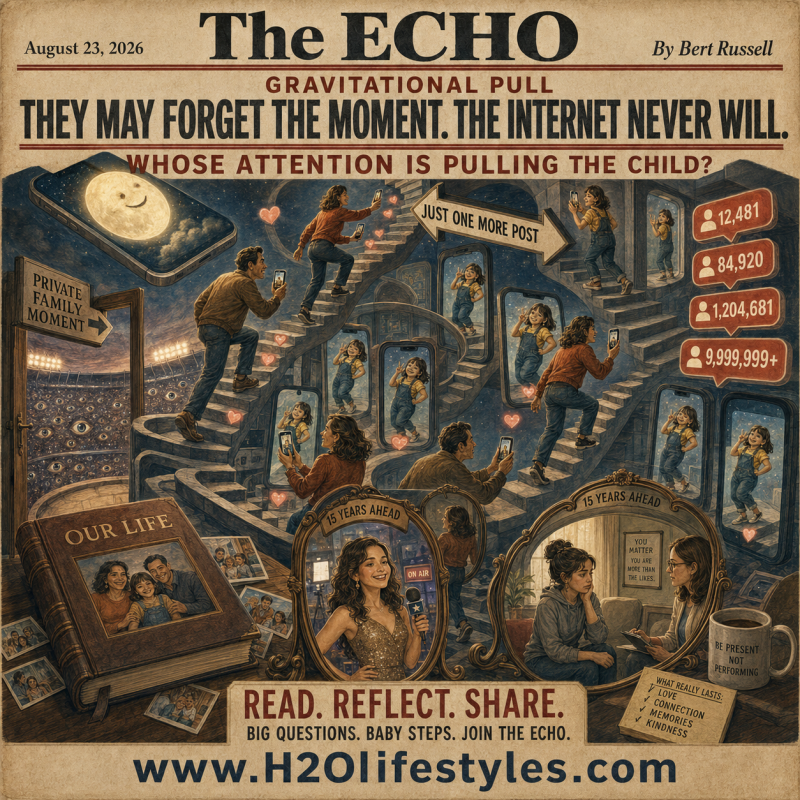

GRAVITATIONAL PULL
WHOSE ATTENTION IS PULLING THE CHILD?
A child naturally follows a parent. But who is the parent following?
August 23, 2026
There was a time when parents took photographs of their children and placed them in a family album.
Maybe the grandparents saw them.
Maybe an aunt or uncle.
Maybe a few close friends.
The embarrassing photograph might come out when the child brought somebody home for dinner.
But the audience was small.
The moment remained mostly inside the family.
Social media changed that.
Today, parents can record a child doing something funny, cute or adorable and immediately share it with hundreds, thousands or even millions of people.
The followers react.
They click hearts.
They leave comments.
They share the video.
The numbers climb.
Before long, the child is no longer simply being a child.
The child has become content.
I originally wanted to say that some parents “flaunt” their children on social media. But flaunt is not quite the right word.
The better description may be that they put their children on display.
I am not saying parents should never share a family photograph.
I understand why parents are proud.
I understand wanting relatives and friends to see a birthday, a school performance, a funny expression or a special moment.
The question is where sharing ends and performing begins.
When a parent repeatedly tells a child to smile, dance, repeat a funny sentence or recreate a private moment for the camera, whose needs are being served?
Is it still about the child?
Or is it about the attention the parent receives?
That attention has a gravitational pull.
The likes pull.
The comments pull.
The follower count pulls.
The possibility of going viral pulls.
Eventually, the parent may stop looking directly at the child and begin looking at the child through a screen.
The child notices what receives approval.
Be funny.
Be cute.
Smile again.
Say it one more time.
Do what you were told.
Children naturally want to please their parents. They may not understand that the performance is being recorded, stored and shown to strangers.
They cannot fully understand digital permanence.
They cannot meaningfully agree to having their childhood turned into a public identity.
A five-year-old cannot imagine being 20 years old and discovering that millions of strangers watched him cry, mispronounce a word, throw a tantrum or experience something deeply personal.
Fifteen years later, that child could grow into someone who loves the spotlight.
Maybe the experience creates confidence.
Maybe the child becomes a model, actor, television personality or successful entertainer.
That is one possible future.
But there is another possibility.
The child may grow up wondering which parts of their personality were real and which parts were performed for approval.
They may struggle with boundaries, privacy, identity or self-worth.
They may eventually need counseling—or even treatment during a serious mental-health crisis.
That does not mean social media automatically causes mental illness.
It means parents cannot know what constant public exposure will mean to a particular child years later.
Every child experiences attention differently.
I do not have biological children.
But I was a child.
I hated being the center of attention.
Why?
Because attention made me easier to spot and easier to catch.
I wanted to be the kid nobody knew at school.
I sat in the back of the classroom.
I spent time with the unknowns.
I did not want to be popular.
Popularity never looked completely real to me. It sometimes seemed like a performance people had to maintain after everyone started watching.
I did not want to be perceived as fake.
I wanted the freedom to observe, think and decide who I was without an audience evaluating every move.
If social media had existed during my childhood, how would I have felt if my private moments had been broadcast to strangers?
Would I have become more confident?
Would I have withdrawn even further?
Would I have trusted the people holding the camera?
I cannot answer those questions.
That is exactly the point.
Parents cannot see 15 years into the future.
They do not know whether the spotlight will become an opportunity or a weight.
Children need room to develop without every stage becoming public entertainment.
They need permission to be awkward.
Permission to make mistakes.
Permission to change.
Permission to have memories that do not belong to an audience.
And sometimes they need permission to sit quietly in the back of the room.
Social media is powerful because it promises connection, recognition and approval.
But when that gravitational pull becomes strong enough, adults may forget who is supposed to be protected.
The camera sees an adorable child.
The followers see entertainment.
The platform sees engagement.
But does anyone see the child behind the performance?
Gravity never stops pulling.
Peace.
Don’t believe it? Read The Last Dispatch.