

THE ECHO: The journey continues
This is a journey, an echo, a small ripple. We invite you to think deeply about the interconnectedness of life and the impact we all have. Discover the profound philosophies of Bert Russell and how they can guide you towards peace of mind, body, and soul. Welcome to a path less traveled, where every thought creates a ripple.

Ignite your thoughts: The ripple effect
We want our audience to think. This is a journey, it is an echo, it is a small ripple. The third perspective is the Gravitational Pull Series, starting this coming week from August 23rd to August 30th. Do not miss it! It is a profound exploration of peace for your mind, body, and soul. ✌️

A message for humanity: Guiding future generations
This journey is meant for the world and all humanity. Specifically, it is for parents with children. Parents with children still have a chance to shape their children's lives for the better, fostering peace of mind, body, and soul. ✌️ Discover insights that can transform your family's journey.

Bert Russell's unique perspective: Seeing beyond the obvious
What makes "THE ECHO - The Journey Continues" truly unique and inspiring? I am just a man with a non-linear ideology. I am dyslexic, and I have Attention Deficit Disorder. I have problems just like everyone else. I am not superior to anyone, and I mean no one! But I can see sequences, patterns, and tangled lines. My brain moves at lightning speed. I can forecast outcomes in patterns quicker than people realize. Do not believe me? Read The Last Dispatch.

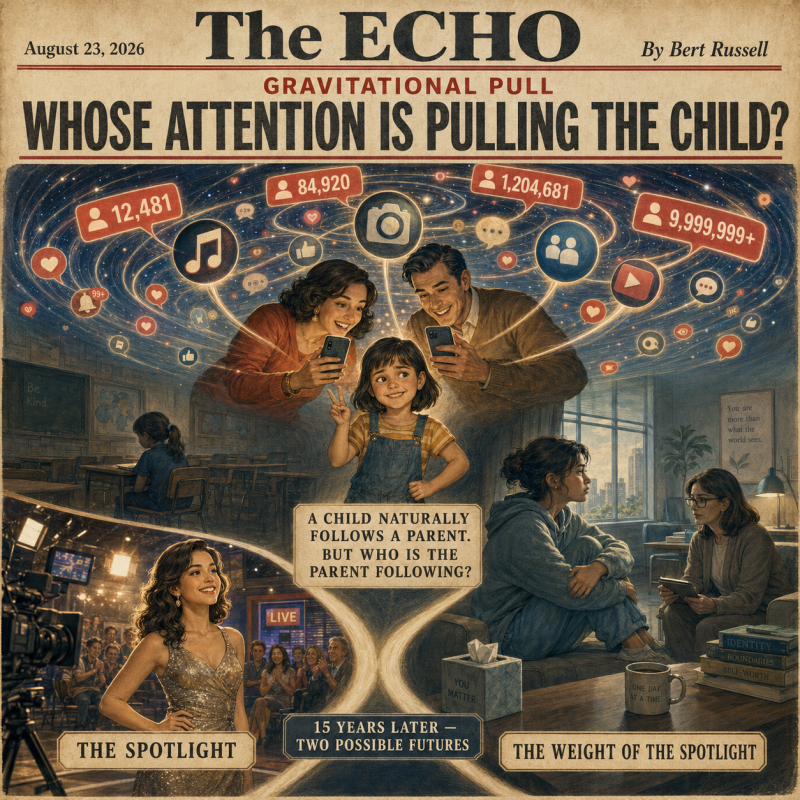
GRAVITATIONAL PULL
WHOSE ATTENTION IS PULLING THE CHILD?
A child naturally follows a parent. But who is the parent following?
August 23, 2026
There was a time when parents took photographs of their children and placed them in a family album.
Maybe the grandparents saw them.
Maybe an aunt or uncle.
Maybe a few close friends.
The embarrassing photograph might come out when the child brought somebody home for dinner.
But the audience was small.
The moment remained mostly inside the family.
Social media changed that.
Today, parents can record a child doing something funny, cute or adorable and immediately share it with hundreds, thousands or even millions of people.
The followers react.
They click hearts.
They leave comments.
They share the video.
The numbers climb.
Before long, the child is no longer simply being a child.
The child has become content.
I originally wanted to say that some parents “flaunt” their children on social media. But flaunt is not quite the right word.
The better description may be that they put their children on display.
I am not saying parents should never share a family photograph.
I understand why parents are proud.
I understand wanting relatives and friends to see a birthday, a school performance, a funny expression or a special moment.
The question is where sharing ends and performing begins.
When a parent repeatedly tells a child to smile, dance, repeat a funny sentence or recreate a private moment for the camera, whose needs are being served?
Is it still about the child?
Or is it about the attention the parent receives?
That attention has a gravitational pull.
The likes pull.
The comments pull.
The follower count pulls.
The possibility of going viral pulls.
Eventually, the parent may stop looking directly at the child and begin looking at the child through a screen.
The child notices what receives approval.
Be funny.
Be cute.
Smile again.
Say it one more time.
Do what you were told.
Children naturally want to please their parents. They may not understand that the performance is being recorded, stored and shown to strangers.
They cannot fully understand digital permanence.
They cannot meaningfully agree to having their childhood turned into a public identity.
A five-year-old cannot imagine being 20 years old and discovering that millions of strangers watched him cry, mispronounce a word, throw a tantrum or experience something deeply personal.
Fifteen years later, that child could grow into someone who loves the spotlight.
Maybe the experience creates confidence.
Maybe the child becomes a model, actor, television personality or successful entertainer.
That is one possible future.
But there is another possibility.
The child may grow up wondering which parts of their personality were real and which parts were performed for approval.
They may struggle with boundaries, privacy, identity or self-worth.
They may eventually need counseling—or even treatment during a serious mental-health crisis.
That does not mean social media automatically causes mental illness.
It means parents cannot know what constant public exposure will mean to a particular child years later.
Every child experiences attention differently.
I do not have biological children.
But I was a child.
I hated being the center of attention.
Why?
Because attention made me easier to spot and easier to catch.
I wanted to be the kid nobody knew at school.
I sat in the back of the classroom.
I spent time with the unknowns.
I did not want to be popular.
Popularity never looked completely real to me. It sometimes seemed like a performance people had to maintain after everyone started watching.
I did not want to be perceived as fake.
I wanted the freedom to observe, think and decide who I was without an audience evaluating every move.
If social media had existed during my childhood, how would I have felt if my private moments had been broadcast to strangers?
Would I have become more confident?
Would I have withdrawn even further?
Would I have trusted the people holding the camera?
I cannot answer those questions.
That is exactly the point.
Parents cannot see 15 years into the future.
They do not know whether the spotlight will become an opportunity or a weight.
Children need room to develop without every stage becoming public entertainment.
They need permission to be awkward.
Permission to make mistakes.
Permission to change.
Permission to have memories that do not belong to an audience.
And sometimes they need permission to sit quietly in the back of the room.
Social media is powerful because it promises connection, recognition and approval.
But when that gravitational pull becomes strong enough, adults may forget who is supposed to be protected.
The camera sees an adorable child.
The followers see entertainment.
The platform sees engagement.
But does anyone see the child behind the performance?
Gravity never stops pulling.
Peace.
Don’t believe it? Read The Last Dispatch.